Difference between revisions of "GIP-Sandbox"

From Global Informality Project
Jump to navigation Jump to search
(Replaced content with "<div class="mainpage_toprow"> <div style="margin-centre:20px"> <span style="font-size: 16px">'''Alena Ledeneva - Pushkin House, 6 March 2024'''</span> <gallery mode=pack...")
Tag: Replaced
Line 1: Line 1:
<div class="mainpage_row_with_2_boxes">
<div class="mainpage_toprow">
<div class="mainpage_image_new" style="min-width:10%">
<div style="margin-centre:20px">
[[File:FringeVersion3v16.png]]
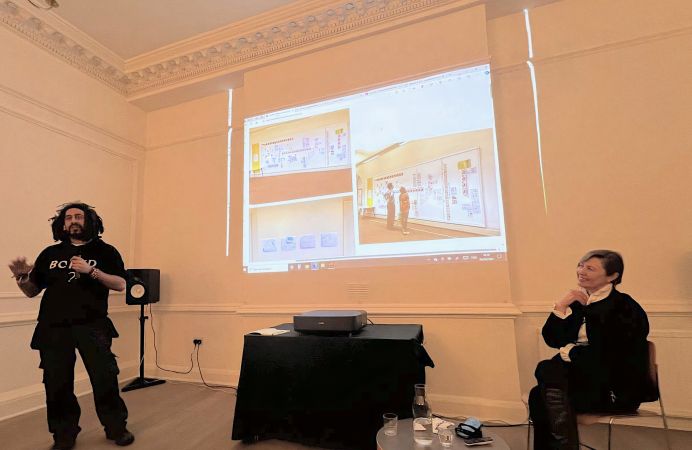
<span style="font-size: 16px">'''Alena Ledeneva - Pushkin House, 6 March 2024'''</span>  
</div>
 
<div style=mid-width:calc(50% - 1em); margin-left:1em">
<span style="font-size:180%; line-height:110%">''This book tells a story of human cooperation. It is not the narrative you’ll find in books teaching you how to solve problems. It is an assemblage of something much more endemic, fundamentally human, and much more pervasive than we tend to think of informality. It involves money and power, but also the alternative currencies of gaining advantage or [[gaming the system]].’ Bruce Schneier, author of A Hacker's Mind</span>
 
<br>
 
<span style="font-size:150%; line-height:110%"><b>‘Alena Ledeneva’s</b> latest database of rule bending is a goldmine for documentary makers and storytellers. Entries from 70 countries, covering a human lifespan from Chinese “anchor babies” to funeral feasts in Azerbaijan, offer remarkable insights into the way the world really works.’ Lucy Ash, journalist.''</span>
 
<div class="mainpage_hubbox_divider"></div>
 
 
The volume takes a reader on a ‘biographical’ journey through elusive, taken-for-granted or banal ways of getting things done from over 70 countries and world regions. It offers innovative understanding of the significance of fringes, and challenges the assumption that informality is associated exclusively with poverty, underdevelopment, the Global South, oppressive regimes or the former socialist countries of Eastern Europe and Central Asia. It also maps the patterns of informality around the globe; identifies specific informal practices in a context-sensitive way; and documents their ambivalent impact on people engaged in problem-solving, on societies in which these problems arise, and on humanity overall.
From February 2024 the volume 3 Encyclopaedia travelled the world . For the past [[events]] see the global book tour.
 
<br>
<br>
<br>
 
<div class="mainpage_boxcontents" style="font-size:110%; text-align: center">
[[File:Published vols download 2.png|20px|link=https://www.uclpress.co.uk/products/232615?_pos=3&_sid=efb9ee999&_ss=r]] '''[https://www.ucl.ac.uk/ucl-press/browse-books/global-encyclopaedia-of-informality-ii Download Volume 3 from UCL Press]'''<br>
 
</div>


<gallery mode=packed heights=300px>
File:Pushkin House - 1.jpg|thumb|200px|left|'''Picture 1'''
File:Pushkin House - 2.jpg|thumb|200px|thumb|left|'''Picture 2'''
File:Pushkin House - 3.jpg|thumb|200px|left|'''Picture 3'''
File:Pushkin House - 4.jpg|200px|left|'''Picture 4'''
</gallery>
</div>
</div>
</div>
</div>
<div class="mainpage_hubbox_divider"></div>
<div class="mainpage_row_with_2_boxes">
<div class="mainpage_image_new" style="min-width:50%">
[[File:GEI vol1 vol2 covers.png|link=Table_of_Contents]]
</div>
<div style=mid-width:calc(50% - 1em); margin-left:1em">
<span style="font-size:180%; line-height:110%">‛''This is a monumental achievement – an indispensable reference for anyone in the social sciences interested in informality.''’</span><br>
Martin Holbraad, Professor of Social Anthropology at UCL and editor-in-chief of Social Analysis
<div class="mainpage_hubbox_divider"></div>
This unique collection invites you on a voyage of discovery, to explore society’s open secrets, unwritten rules and know-how practices. Broadly defined as ‘ways of getting things done’, these invisible yet powerful informal practices tend to escape articulation in official discourse. They include emotion-driven exchanges of gifts or favours and tributes for services, interest-driven know-how (from informal welfare to informal employment and entrepreneurship), identity-driven practices of solidarity, and power-driven forms of co-optation and control. The Global Encyclopaedia of Informality contains over 200 entries. From March 2018 to April 2019 the Encyclopaedia travelled the world on a [[Global Book Launch Events|global book tour]].
</div>
</div>
<div class="mainpage_hubbox_divider"></div>
<div class="mainpage_row2">
<div class="mainpage_hubbox">
        <div class="mainpage_boxborder" style="margin-bottom:5px"> </div>
        <div class="mainpage_boxcontents" style="font-size:110%; text-align: center">
[[File:Published vols download 2.png|20px|link=http://www.ucl.ac.uk/ucl-press/browse-books/global-encyclopedia-of-informality-i]] '''[http://www.ucl.ac.uk/ucl-press/browse-books/global-encyclopedia-of-informality-i Download Volume 1 from UCL Press]'''<br>
<div class="mainpage_hubbox_divider" style="margin:0.5em"></div>
<small>with an '''introduction''' by Alena Ledeneva,<br>80 entries and contribution by Zygmunt Bauman</small>
</div>
</div>
<div class="mainpage_hubbox">
        <div class="mainpage_boxborder" style="margin-bottom:5px"> </div>
        <div class="mainpage_boxcontents" style="font-size:110%; text-align: center">
[[File:Published vols download 2.png|20px|link=https://www.ucl.ac.uk/ucl-press/browse-books/global-encyclopaedia-of-informality-ii]] '''[https://www.ucl.ac.uk/ucl-press/browse-books/global-encyclopaedia-of-informality-ii Download Volume 2 from UCL Press]'''<br>
<div class="mainpage_hubbox_divider" style="margin:0.5em"></div>
<small>featuring more than 100 authors,<br>including Sheila Fitzpatrick and Vladimir Gelman</small>
</div>
</div>
<div class="mainpage_hubbox">
        <div class="mainpage_boxborder" style="margin-bottom:5px"> </div>
        <div class="mainpage_boxcontents" style="font-size:110%; text-align: center">
'''Read online'''
<div class="mainpage_hubbox_divider" style="margin:0.5em"></div>
'''[[The informal view of the world|Introduction]]''' | '''[[Main Findings|Main findings]]'''<br>
'''[[Table of Contents|Table of contents]]''' | '''[[Theoretical Framing of the Database|Theoretical framing]]'''
</div>
</div>
</div>
==Short introduction to the volumes==
{{#evu:https://www.youtube.com/watch?v=oMlPMGmCrYw|dimensions=600x338}}
==Reviews==
'''Fradejas-García, Ignacio''':
"In conclusion, this encyclopedia, due to its inherent comparative character, allows use its typology, which has been defined extensively in each chapter, both in the introductions as well as specific conclusions, to classify practices informal to be investigated in the future globally. However, we were wrong if we see the encyclopedia as an Encyclopedia with capital letter: both the Chapter introductions, like many of the entries, subsume a huge quantity of analytical and theoretical reflections of enormous depth. Yes, still If there were door-to-door encyclopedias sellers, this would be a bestseller."
''Perifèria'' 23(2), 2018.
[in Spanish] [https://doi.org/10.5565/rev/periferia.658 'Reseña de “The Global Encyclopaedia of Informality: Understanding Social and Cultural Complexity” de Alena Ledeneva (Ed.)']
'''Hupp, S. L.''', West Virginia University at Parkersburg:
"To quote lead editor Ledeneva, this work deals with “the world’s open
secrets, unwritten rules, and hidden practices” as “ways of getting things
done.” This complex, highly theoretical book examines the use of family
contacts, friendships, bribes, favors, cronyism, language, and other informal
practices throughout human society. Essays, written by a score of scholars,
fall into four parts: redistribution (the role of relationships), solidarity
(conformity versus nonconformity), markets (economics), and domination
(power). Each section has a preface and conclusion. The entries are not
arranged in alphabetical order or in a time line. Rather, similar practices
followed in different countries are grouped together and identified by the
local term. Each chapter ends with a detailed bibliography. A glossary of
these terms appears in both volumes, which the editors suggest should serve
as the starting point for the reader. Detailed indexes are also included. A
larger number of terms included come from Russia and Eastern Europe and
date back to the communist era. An outgrowth of the Global Informality
Project, this book provides interesting insights into how similar practices
are carried out across different cultures. This work is not intended as a
ready reference or for undergraduates but stands as a complex study suited
for graduate students, scholars, and professionals."
''The Choice'', April 2019: 939.
==About the FRINGE Centre for the Study of Social and Cultural Complexity==
The [https://www.ucl.ac.uk/ssees/ucl-school-slavonic-east-european-studies-ssees FRINGE Centre] explores the roles that complexity, ambivalence and immeasurability play in social and cultural phenomena. A cross-disciplinary initiative bringing together scholars from the humanities and social sciences, FRINGE examines how seemingly opposed notions such as centrality and marginality, and clarity and ambiguity, can shift and converge when embedded in everyday practices. Our interest lies in the hidden complexity of all embedded practices, taken-for-granted and otherwise invisible subjects. Illuminating the 'fringe' thus puts the 'centre' in a new light.
The FRINGE Centre publishes the [https://www.ucl.ac.uk/ssees/fringe-centre/publications FRINGE series] with [http://www.ucl.ac.uk/ucl-press UCL Press].

Revision as of 10:51, 27 April 2024

Alena Ledeneva - Pushkin House, 6 March 2024